If you've been holding back on speaking French at home because your grammar isn't quite right or you're conscious of your learner's accent, you're not alone! So many parents hold themselves back from using French at home for fer that they might "pass on their mistakes", or something along those lines.
Here's what I want you to know: your French is already good enough to help your child (even if you have zero knowledge to begin!). You don't need perfect French for your child to benefit from hearing it. Every word you say in French, even if the pronunciation is a little off, tells your child that this language matters.
Let's walk through what your child is actually picking up, and how to start with just a few words & phrases.
Does Imperfect French Help, or Is It Better to Say Nothing?
I promise it helps : Exposure is what builds familiarity, and familiarity is what helps make French feel safe and "normal" to your child.
Even a handful of simple French phrases repeated often can build listening comprehension over time and increase your child's familiarity with the language.
As a French teacher, I can confirm that children who hear some French at home, even imperfect French, feel more comfortable with it than children who've heard none at all, and they also tend to be more eager and willing to speak it.
Here are a few routine phrases you can use right away:
C'est l'heure du bain!
= It's bath time!, Pron: “saih luhr dew baih”
On mange!
= We're eating!, Pron: “ohw mawj”
Bonne nuit
= Good night, Pron: “buhn nwee”
Je t'aime
= I love you, Pron: “juh taihm”
Ferme les yeux
= Close your eyes, Pron: “faihrm lay-zyuh”
Encore?
= More?, Pron: “aw-kohr”
C'est bon!
= It's good!, Pron: “saih bohw”
Bath Time and Mealtime
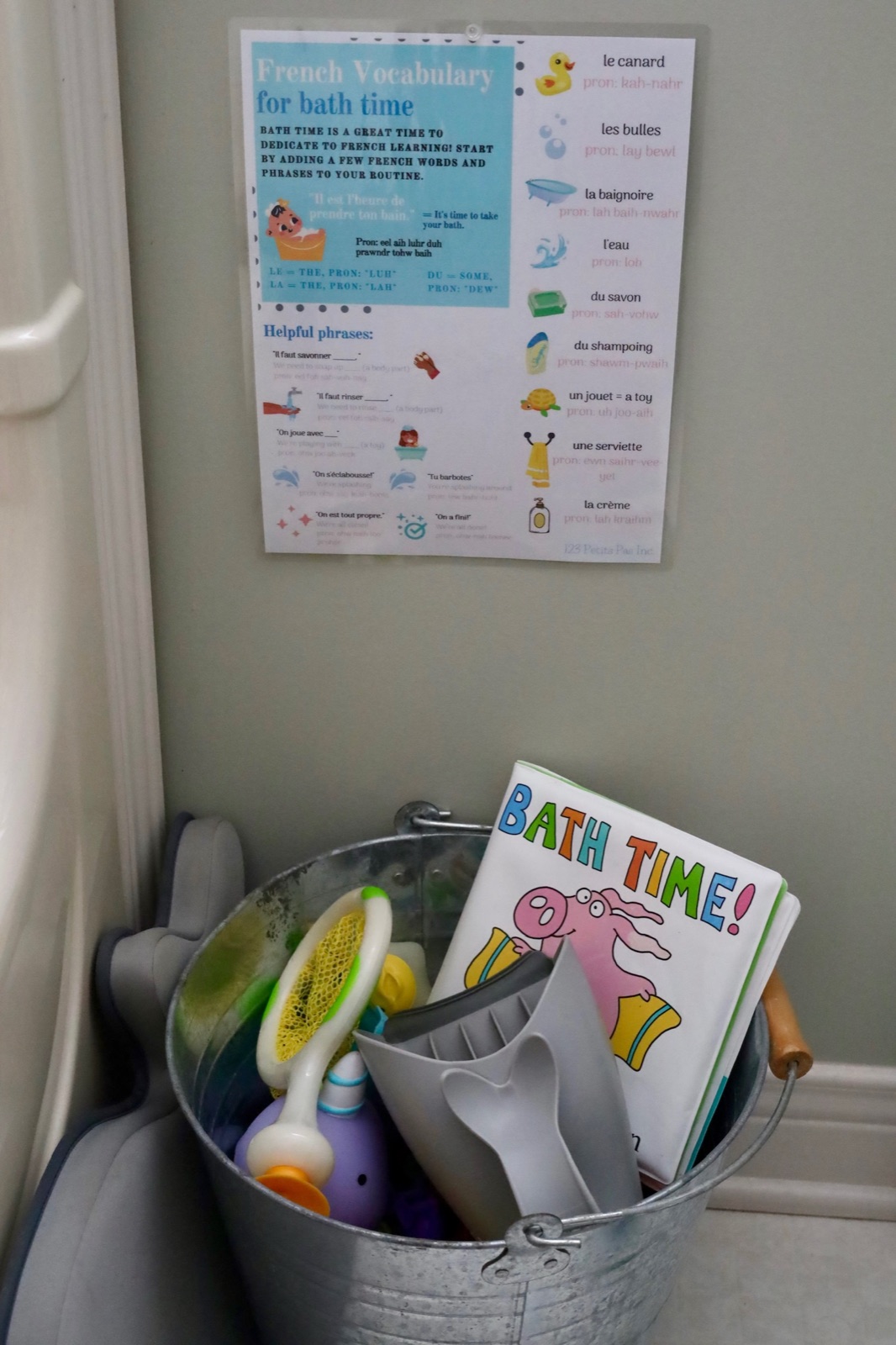
Bath time is great for body parts, action words, and simple instructions. "Ferme les yeux" (close your eyes) before you rinse their hair is an easy one to say every night. Start with "C'est l'heure du bain!" as you head to the tub.
Mealtime is easy for food names, "encore?" (more?) when they want seconds, and "c'est bon!" (it's good!) after a bite. Calling out "On mange!" when a meal is ready is a simple way to start every meal en français.
Bedtime
Bedtime is one of the best moments for French because it's calm and cozy, and most families have some kind of bedtime routine. A simple "Bonne nuit, je t'aime" (Good night, I love you) at the end of the day is a lovely place to start.
With my boys, I like to say: "Fais de beaux rêves" = French's way of saying "sweet dreams". Pronounced: "faih duh boh raihv".
How to Start This Week
To begin using French with your children TODAY, here's what I recommend:
- Choose your French moment Pick a daily routine like bath, bedtime, snack time, or getting dressed.
- Write one phrase on a sticky note Put it somewhere you'll see it during that moment, like the bathroom mirror or the fridge.
- Say that phrase in French instead of English every time this week! Do it for a whole week before adding anything else. Why? Because often people start BIG and then it's too big of a change and they find themselves unable to stick to it, which them leads them to drop French completely. Instead, start with 1 petit pas, one little step ;), and we can add on gradually from there.
Madame Amy's tip:
Need some pronunciation support? Try typing your phrase into a translator like Google Translate and listening to the audio!
Can my imperfect French confuse my child's language development?
Children are experts at language learning. Introducing a second language is not going to hinder their ability to learn their first language and unless you are the ONLY French exposure they have, they're very unlikely to have the same accent or make the same mistakes as you (because their French learning journey will be much different from yours!).
I, for example, have chosen to speak only French with my children (I am fluent enough to do so). However, because their language learning journey is very different from mine, they do not have "my accent". They attend Francophone school, and have been speaking French since they were infants. Whereas I learned French starting from age 5 as a second language.
That said, if you ever have concerns about your child's speech or language development, talk to your doctor or a speech-language pathologist.
I only know a handful of French words. Is that really enough to do anything useful?
Yes, especially if you use them daily! Repetition is how language gets absorbed. Three phrases used consistently across daily routines will do more than thirty phrases used once and then forgotten.
What if my child corrects my French someday?
That's a good sign. It means they've been listening and building knowledge beyond what you were able to model. You gave them a foundation, and they built on it. That's literally the goal!
Do I need to be in a French immersion program or have a French-speaking partner for this to work?
No. Plenty of children develop a comfort with French just from a parent who tried at home, consistently, with whatever French they had. You don't need a French-speaking co-parent or a formal program to make a difference. If your partner doesn't speak French, here are some ideas for including a parent who doesn't speak French.
How much French do I need to speak per day for it to matter?
There's no magic number, but small and consistent beats big and occasional. Even five to ten minutes of French spread across your routines each day adds up over time. The goal right now is making it feel normal to your child.
I have a bad French accent. Will that affect my child negatively?
In my opinion, there's no such thing as a "bad accent". Accents are our language learning stories. We can of course work on our pronunciation, but our accents? We don't really have a choice in the matter. Your child will pick up the vocabulary and the interest of French learning from you, but they'll also hear other accents through books, songs, videos and maybe school too. Their journey is going to be different than yours, and so, they will have a different accent than you. 🙂 Aren't accents just fascinating?!
Would you like our support with French learning at home?
If you'd like low-pressure French phrases organized by daily routine, the Crash Course in Baby/Toddler French is a podcast-style audio course made for this, for ages 0 to 2. You can listen while you fold laundry, nurse or drive. No screens, and no perfection required.
If your child is a bit older, the French @ Home Membership (ages 0 to 9) has live themed classes, on-demand lessons and resources you can do together.